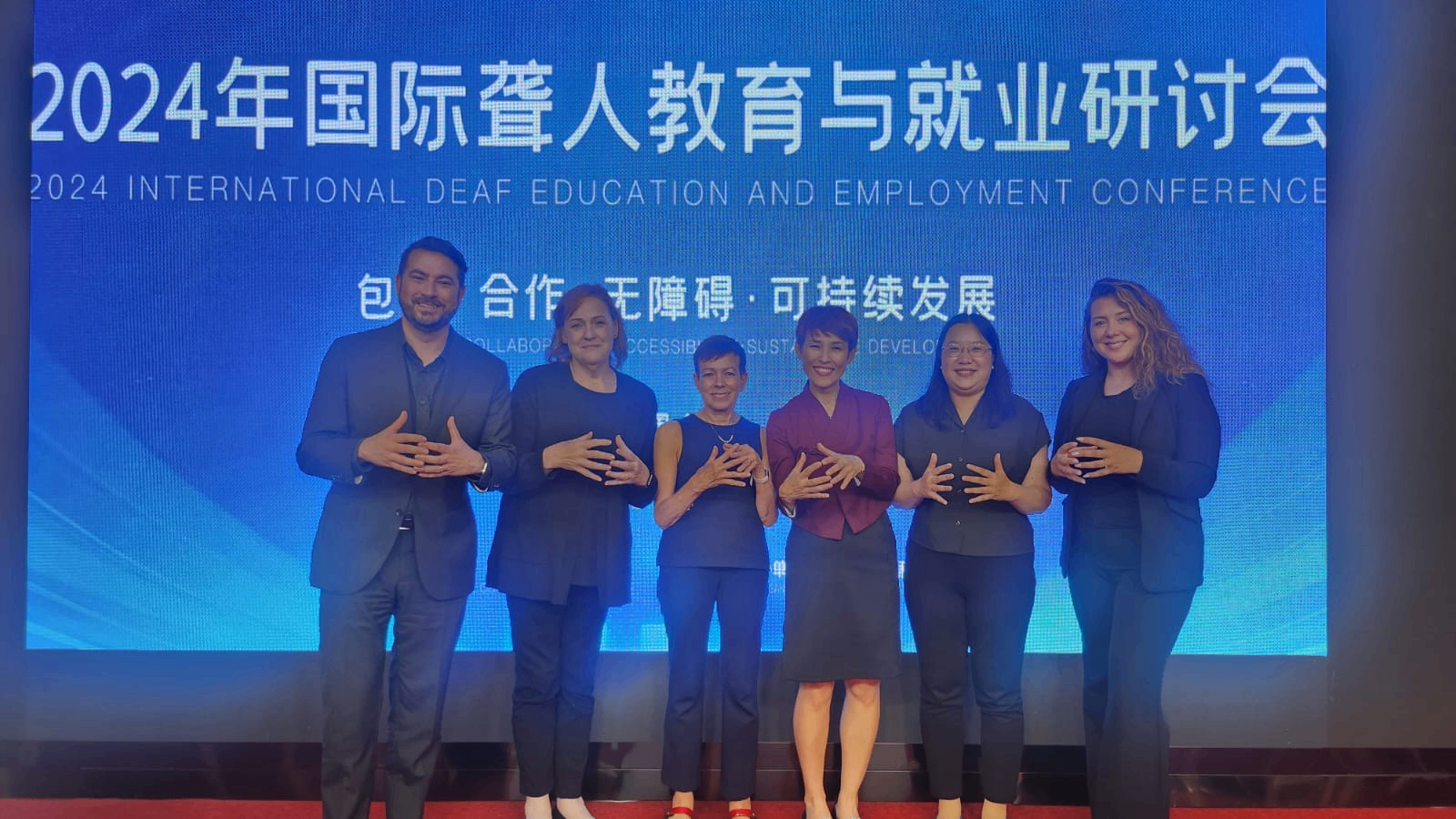
Designing Inclusive & Accessible Audiovisual Environments
1. High-Fidelity Visual Staging & Sign Language Sightlines
For Deaf and hard-of-hearing attendees, clear visual access is not a secondary consideration—it is the fundamental medium of communication. Standard conference staging often places speakers behind dark lecterns or in shadow, making facial expressions and hand gestures illegible from distance.
GoodAV implements accessibility-first staging design. We configure wide, unobstructed stages equipped with ultra-bright, high-contrast P2.6 LED video walls. Downstage IMAG (Image Magnification) screens are strategically positioned at natural eye level across the auditorium, ensuring that attendees seated anywhere in the hall have an uninhibited view of both spoken-language presenters and working sign language interpreters.
2. Picture-in-Picture (PiP) Broadcast Switching & Dedicated Interpreter Feeds
Live streaming an accessibility-focused conference requires dedicated camera choreography. GoodAV utilizes broadcast switchers to generate dual broadcast feeds: a primary mixed feed and a dedicated high-definition picture-in-picture (PiP) sign language stream.
Our camera operators follow strict framing guidelines: maintaining an uncropped upper-body frame that captures the full signing space—from the top of the head to below the waist, including hand shapes, finger spelling, and critical facial grammar. On-screen graphics and presentation slides are dynamically scaled so that the interpreter feed is never obscured or minimized.
3. Low-Glare, High-CRI Broadcast Lighting
Sign language comprehension heavily depends on reading micro-expressions and distinct hand shadows. Harsh or uneven stage lighting creates eye fatigue and obscures subtle facial signals.
GoodAV installs high Color Rendering Index (CRI 95+) diffuse LED lighting arrays. By utilizing soft front-fill and calibrated back-lighting, our lighting engineers eliminate distracting shadows and harsh glare, creating a comfortable visual environment for both in-person attendees and camera sensors throughout multi-day sessions.
4. Dual-Track Audio & Spoken-Language Sound Engineering
The AFSLI conference operates with continuous bidirectional interpretation: spoken languages (English, French, Kinyarwanda) translated into national sign languages, and deaf presenters signing onstage voiced by spoken-language interpreters.
GoodAV engineers dedicated audio monitoring loops for spoken-language interpreters, allowing them to hear clear, latency-free audio feeds from lavalier microphones while voicing onstage presentations into the room's PA system with zero echo or feedback.